 My Bookshelf
- Home
- Accounting, Finance and Auditing for Lawyers
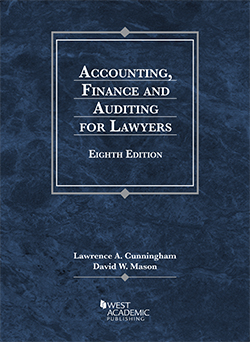
Accounting, Finance and Auditing for Lawyers

This book, now in its eighth edition and adopted at nearly 100 schools in its 25-year history, presents accounting, finance and auditing using clear narrative with extensive illustrations. Written by two leading teachers and practitioners of law and accounting, it balances accessibility with rigor. Pedagogical features that make this book easy to use include a coherent layout, complete set of PowerPoint slides, comprehensive Problems and Solutions, intriguing Conceptual Questions and International Comparisons plus a Glossary, Bibliography, Index and Teacher’s Manual. It can be used as the primary book for a one-, two- or three-credit accounting course or to supplement business associations, corporations or corporate finance courses.
Imprint: West Academic Publishing
Series: American Casebook Series
Publication Date: 06/14/2023
Lawrence A. Cunningham, George Washington University Law School
David W. Mason, Boston College Law School
CasebookPlus™
This title is available in our CasebookPlus format. CasebookPlus provides support beyond your classroom lectures and materials by offering additional digital resources to you and your students. Anchored by faculty-authored formative self-assessments keyed to our most popular casebooks, CasebookPlus allows students to test their understanding of core concepts as they are learning them in class – on their own, outside of the classroom, with no extra work on your part. CasebookPlus combines three important elements:
- A new print or digital casebook
- Access to a downloadable eBook with the ability to highlight and add notes
- 12-month access to a digital Learning Library complete with:
- Chapter questions keyed to the casebook
- Black Letter Law questions (available in select subjects)
- Subject area review questions for end of semester use
Leading digital study aids, an outline starter, and audio lectures in select subjects
Students can still utilize CasebookPlus digital resources if they’ve purchased a used book or are renting their text by purchasing the Learning Library at westacademic.com.
With CasebookPlus, you can customize your students’ learning experience and monitor their performance. The quiz editor allows you to create your own custom quiz set, suppress specific quiz questions or quiz sets, and time-release quiz questions. Additionally, the flexible, customized reporting capability helps you evaluate your students’ understanding of the material and can also help your school demonstrate compliance with the new ABA Assessment and Learning Outcomes standards.
The most important change to the new edition is bringing in David Mason as an additional editor to join Lawrence Cunningham who remains onboard. Mason, a JD and former CPA who has practiced both private law and public accounting, taught the Law & Accounting course at Boston College Law School for 15 years (and prior to that was Cunningham's Teaching Assistant for that course during his second and third years). While maintaining the classic approach teachers and students have loved about the book for more than 25 years, Mason has made it even more user friendly based on his first-hand experience.
Learn more about this series.
Access Denied
Law School Faculty - Sign in or Create an Account to access this content. Law faculty who have created an account can sign in after receiving email notification that registration has been approved. Email accountmanager@westacademic.com or call 800-313-9378 for assistance.
Other Higher Education Faculty who wish to access digital review copies or teaching resources should contact their West Academic Account Manager at college@westacademic.com or 800-360-9378.
Adopters Only
This content is intended for adopters only. Sign in or Create an Account to access this content. Law faculty who have created an account can sign in after receiving email notification that registration has been approved. If you are an adopter who is unable to access this content after signing in, contact your account manager for assistance at accountmanager@westacademic.com or call 800-313-9378 for assistance.
Access Denied
Sign in or Create an Account to access this content. Faculty who have created an account can sign in after receiving email notification that registration has been approved. Contact us for assistance.
Law School Faculty: email accountmanager@westacademic.com or call 800-313-9378.
Other Higher Education Faculty: email college@westacademic.com or 800-360-9378.
Access Denied
Higher education faculty who wish to view this document should contact their West Academic Account Manager at college@westacademic.com or 800-360-9378.